Bogs are quiet. They stand still, frozen in time, preserving a prehistoric, boreal ecosystem formed by glaciers thousands of years ago. Although old, they are full of life, and densely packed with sphagnum moss, also known as peat moss. Sphagnum in a bog acts like a giant green sponge: it’s luscious, absorbent, and, if you ever have the pleasure of walking on some, quite bouncy. This, and layers of dead vegetation create the foundation of a bog. There are many types of bogs (raised, blanket, valley, quaking, cataract) that go by different names in different parts of the world (muskeg, quagmire, mire, peatland). They all form similarly, in that they wouldn’t be here without glacial meltwater. For this entry, I am going to focus on my favorite type: kettle hole bogs.
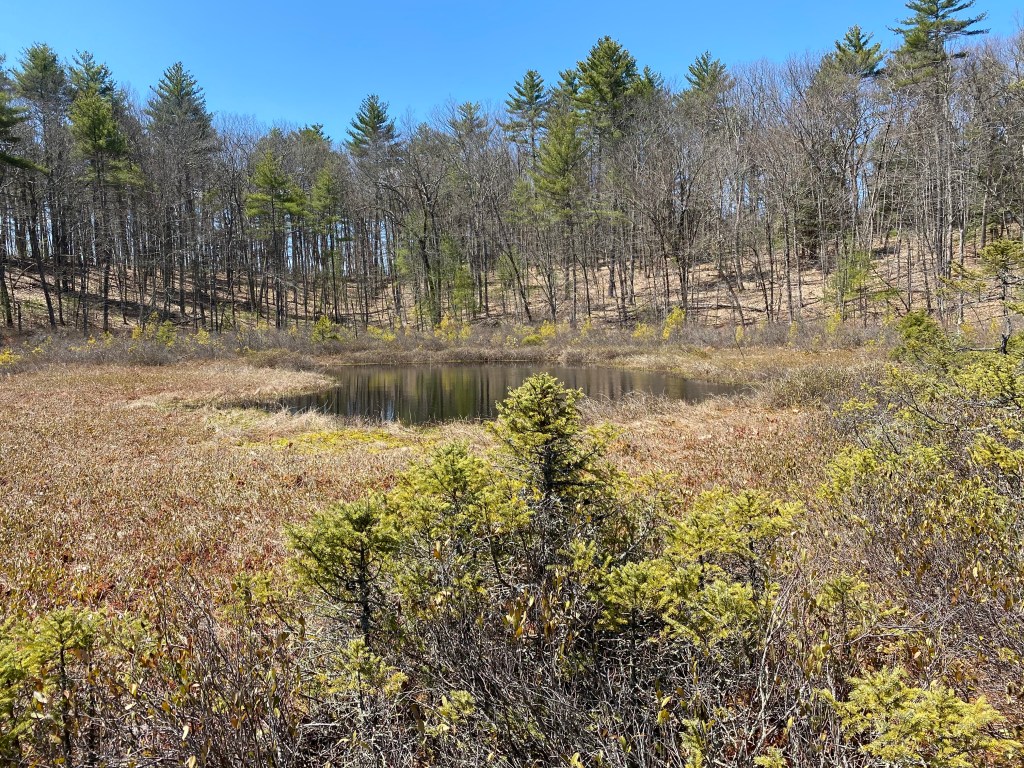
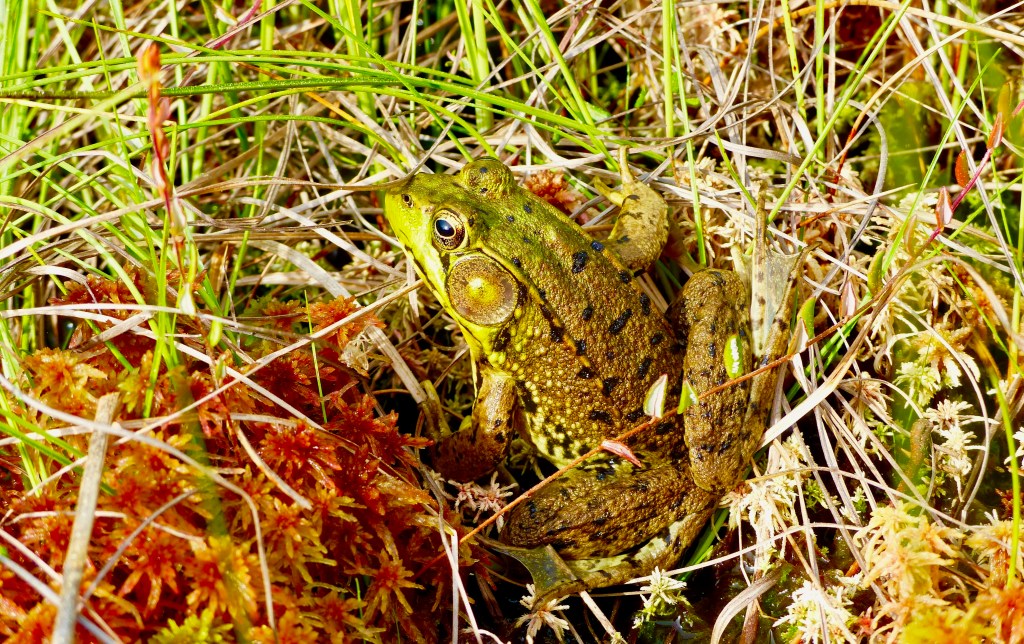
Bogs are aquatic ecosystems but have no inlet and no outlet for water to flow. So how did they become wet? Glaciers. When the Laurentide Glacier eventually retreated from its most southern reaches of North American to where it remains today in the most northern latitudes of the globe, it left chunks on ice along its path. These chunks were massive and dense and usually formed depressions in flat surfaces of the earth as they sat there in isolation. Eventually the chunks melted, filling in that depression with glacial meltwater. At this point, a lake has formed and is teaming with plant and animal life. Eventually, plants like sphagnum moss creep in, complete their lifecycle, sink to the bottom of the lake, and decompose. This process repeats over thousands of years. Eventually the lake fills from the bottom up, creating anywhere from 10 – 60 meters (32 – 192 ft) of dead plant material until the gap between it and the living sphagnum on the surface of the water is closed. You now have a kettle hole bog and it only took 11,000 years! Often one or several portions of the lake is left unfilled, creating small pond-like habitat for frogs, turtles, salamanders, and dragonflies.
Aside from the development of bogs that make them so fascinating, the modern plant life that has adapted to grow there is completely geek-out worthy. Sphagnum generates hydrogen ions making conditions acidic for other plants. When patches of sphagnum die and fill in the lake, they also release tannic acid into the water. Lacking drainage, the lake turns darker as these acids become more concentrated and stain the water, much like a pot of water into which tea bags are continually added. The acidity restricts the species that can survive in the bog, severely limiting even bacteria which are the primary drivers decay (and explaining the discoveries of perfectly preserved, 2000-year-old “mummies” within some northern European bogs). Nutrients like nitrogen, calcium, and phosphorous remain locked up in the vegetation instead of being recycled back into the environment where other plants can use them.
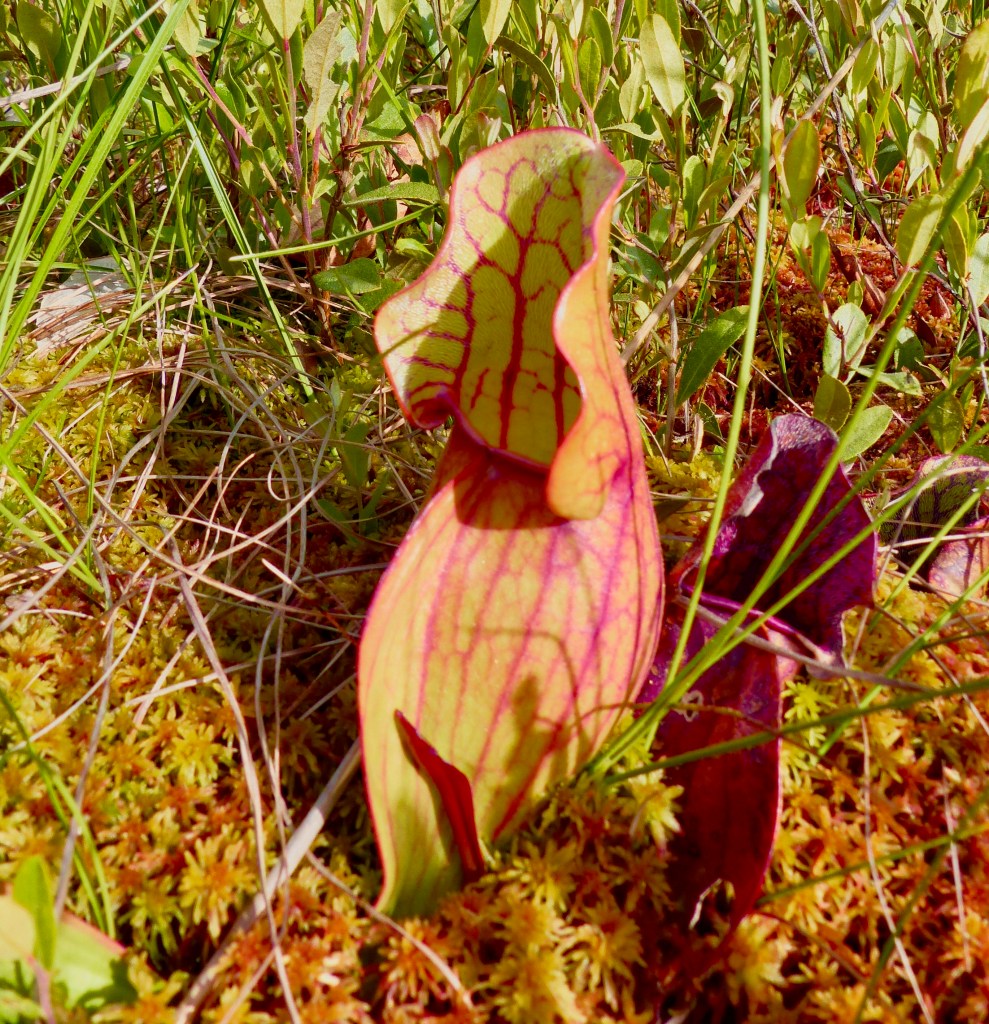
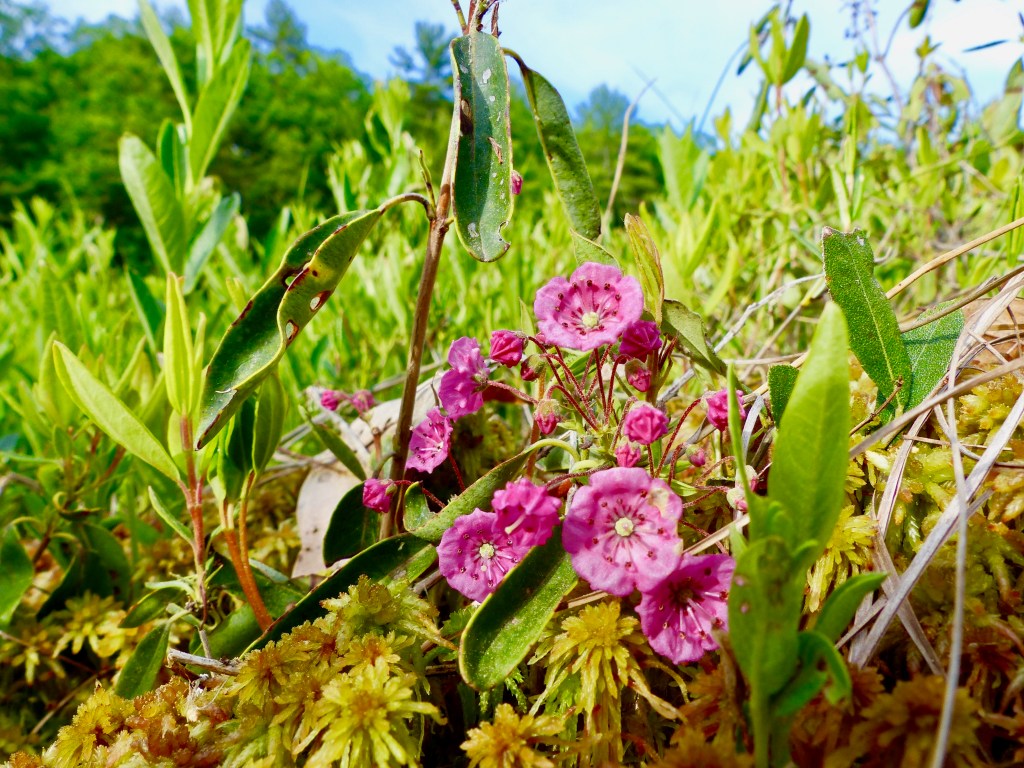
In this type of environment where essential nutrients are lacking, some plants have adapted to supplementing their need for nitrogen by uptaking it through insects! Plants that do this include the pitcher plant (Sarracenia purpurea) and sundew (Drosera spp.). The pitcher plant, with its large, tubular, red-veined leaves and tall, striking red flowers, is easy to recognize. Stiff, downward-pointing hairs coat the inside surface of the open pitchers, preventing the escape of insects which drown and are then digested in the plant’s liquid reservoir. This enriched liquid is then absorbed by the plant. Much smaller is the sundew plant, whose leaves are quarter-inch disks covered with sticky glandular tentacles. Lured to this glistening “nectar”, a small insect becomes stuck and dies, and the sundew absorbs the nutrients resulting from its decomposition. Non-insectivorous plants that grow in bogs belong to the heath family (Ericaceae) and thrive in acid soil. Species include tart and tasty cranberries (Arctostaphylos uva-ursi), sun-sweeten blueberries (Vaccinium corymbosum), and fragrant bog rosemary (Andromeda polifolia).

In an brochure written by John Serrao for the Nature Conservancy, these unique ecosystems are summed up best as:
“
cold, soggy, poorly-drained, acidic, moss-covered, oxygen-starved, and nutrient deficient environment descended from a glacial depression – in shot a bog!
“
And there are plenty of them in my neck of the woods, so I hope you’ll join me in discovering their wonders!
 The Bog Blogger
I. Freaking. Love. This. I wish every wetland scientist could read this first when trying to understand one or life’s toughest questions: what even is a bog?
LikeLike
So true, Grant. I’ll be here with the answers!
LikeLike
Hi Sarah, I just stumbled upon this bog blog 4 years in the future from when you wrote this. I’m not sure if you’re still active here but I wanted to say thanks for creating this! Last year I visited Quoddy Head state park with my boyfriend sort of on a whim. We were camping at Cobscook Bay State Park and wanted to explore. I had never seen such a wonderful place. The hiking along the craggy grey shoreline was startling and crisp – and then! – to curve inland and find yourself in a bog? WOW. The bog there transformed me and wooed me. I’ve been obsessed with thinking about bogs now. I’m planning some more local bog trips (I live in the Hudson Valley of New York) for later in the summer. Thinking about that, I am excited to read further about your experiences. Are there other places gushing about bogs? (I’m not a trained environmental scientist but I do have deep relationships with plants and places!)
LikeLiked by 1 person
Hi Mandy! Thanks for your comment. I’m so delighted to hear that you were wowed by the bogs at Quoddy! I don’t know of any other bloggers out there who write about bogs, but I do know that you will have some luck finding bogs in the Adirondacks! Please let me know if you made a trip out there, I’d love to hear any of your recommendations.
LikeLike